My work is a family study, rather than an family history in the genealogical sense of tracing ancestors. So although Thomas here had no descendants, he is as important to me as if he had, and even more so because it was with his help I linked in part of the family - ie the Ginn/Genn family of Ely and as of the turn of 2019/20 he is becoming even more important.
Tom Ginn was a contemporary of Shakespeare, was 22 when Drake defeated the Spanish Armada, lived through virtually the whole of the reign of Elizabeth the 1st, the Gunpowder Plot and clearly knew the young Oliver Cromwell. I would like to have chatted to him.
Tom Ginn was a contemporary of Shakespeare, was 22 when Drake defeated the Spanish Armada, lived through virtually the whole of the reign of Elizabeth the 1st, the Gunpowder Plot and clearly knew the young Oliver Cromwell. I would like to have chatted to him.
Thomas was one of the younger sons of Robert Ginn of Wyton and Houghton, mentioned in my post of 7th July 2012. In a world where the eldest son was supposed to inherit everything, he was supposed to always play "second fiddle" to his elder brother Robert, but nobody seems to have told Tom.
The registers for Wyton and Houghton for the period have not survived for this period, and until 2020 although I knew a fair bit about the start of Tom's life and his end, I knew only a little about what happened in the middle.
Thomas was about the age of four when he arrived in Wyton and Houghton in Hunts from Anstey in Hertfordshire with his parents, so never knew anything much of where he was born, except perhaps from later visits with his Mum and Dad.
England was a Protestant country at a time when most of Western Europe was Catholic, and in 1588 Catholic Spain launched the "Spanish Armada" to sail to England with an army, invade and forcibly convert the population to the Pope.

Although England had a fine navy, this was the time of Drake and Hawkins, it had no standing army, and relied on what were known as the Trained Bands from the Counties, a militia comprised of at best a few professional officers, with largely the local gentry as leaders with the volunteer muster comprising mostly the sons of yeomen, who being "propertied" were considered to have a stake in the Nation and obliged by law to maintain arms.
England was under serious threat, and Queen Elizabeth 1st raised the Trained Bands (we have seen that one Ginn went from Hertfordshire - see post of 19th July 2012 ) and, amazingly, records survive showing that Thomas here, aged 22, volunteered and was in the Huntingdonshire Trained Band.
The major gentry family in Huntingdonshire were the Cromwells, who played a part in the stories of several members of this side of the Ginn/Genn family. The Cromwell family were to keep the 1588 records of the Huntingdonshire Trained Band, which in August 1588 was at Tilbury where it met the Queen who gave her famous speech.

There were 400 men, comprised of two companies, one of which was led by Oliver (later Sir Oliver) Cromwell of Hinchinbrook (below) who was uncle to the Oliver Cromwell of the English Civil War fame

Thomas Ginn was in Cromwell's company, there is a transcript of the original Muster, above, and Tom had been trained to fire the light weight musket known in his day as a Caliver or Qualifer hence the "Q" by his name, Tom looking somewhat like the Trained Band soldier of 1588 represented in the middle of the group below.

Luckily, the Trained Bands were never to face the Spanish Army, their ships blown away by Drake and his men and storms taken by the English to be the will of their Protestant God.

What seems pretty clear from the records is that Tom's father did not (unlike his father and grandfather) establish his children, particularly his sons before he died. Even Robert junior, although he married, does not seem to have been given the wherewithal to develop his own independence before his father died.
I have speculated for some years that Thomas married twice, firstly to a Helen Gregory (who may have come from close to St Ives in Hunts) at Ely in 1596. This is speculation. What is known for a fact is that by 1598 he was married to an Ann Torkington.
Ann came from the gentry family of that name in Great Stukeley near Huntingdon. I did not know that for a fact until just before Christmas 2021. Hers was a prominent family in the area.
Thomas was about the age of four when he arrived in Wyton and Houghton in Hunts from Anstey in Hertfordshire with his parents, so never knew anything much of where he was born, except perhaps from later visits with his Mum and Dad.
England was a Protestant country at a time when most of Western Europe was Catholic, and in 1588 Catholic Spain launched the "Spanish Armada" to sail to England with an army, invade and forcibly convert the population to the Pope.

Although England had a fine navy, this was the time of Drake and Hawkins, it had no standing army, and relied on what were known as the Trained Bands from the Counties, a militia comprised of at best a few professional officers, with largely the local gentry as leaders with the volunteer muster comprising mostly the sons of yeomen, who being "propertied" were considered to have a stake in the Nation and obliged by law to maintain arms.
England was under serious threat, and Queen Elizabeth 1st raised the Trained Bands (we have seen that one Ginn went from Hertfordshire - see post of 19th July 2012 ) and, amazingly, records survive showing that Thomas here, aged 22, volunteered and was in the Huntingdonshire Trained Band.
The major gentry family in Huntingdonshire were the Cromwells, who played a part in the stories of several members of this side of the Ginn/Genn family. The Cromwell family were to keep the 1588 records of the Huntingdonshire Trained Band, which in August 1588 was at Tilbury where it met the Queen who gave her famous speech.
There were 400 men, comprised of two companies, one of which was led by Oliver (later Sir Oliver) Cromwell of Hinchinbrook (below) who was uncle to the Oliver Cromwell of the English Civil War fame

Thomas Ginn was in Cromwell's company, there is a transcript of the original Muster, above, and Tom had been trained to fire the light weight musket known in his day as a Caliver or Qualifer hence the "Q" by his name, Tom looking somewhat like the Trained Band soldier of 1588 represented in the middle of the group below.

Luckily, the Trained Bands were never to face the Spanish Army, their ships blown away by Drake and his men and storms taken by the English to be the will of their Protestant God.

What seems pretty clear from the records is that Tom's father did not (unlike his father and grandfather) establish his children, particularly his sons before he died. Even Robert junior, although he married, does not seem to have been given the wherewithal to develop his own independence before his father died.
I have speculated for some years that Thomas married twice, firstly to a Helen Gregory (who may have come from close to St Ives in Hunts) at Ely in 1596. This is speculation. What is known for a fact is that by 1598 he was married to an Ann Torkington.
Ann came from the gentry family of that name in Great Stukeley near Huntingdon. I did not know that for a fact until just before Christmas 2021. Hers was a prominent family in the area.

The Torkingtons reputedly originate from Torkington Hall in Cheshire. A Henry Torkington of that family married into the Stukeley family of Great Stukeley in Huntingdonshire in the early 16th century. The Stukeleys (as their name suggests) had held the manor of Great Stukeley for time immemorial. The Torkingtons thus acquired that manor and two others besides. Henry and his wife Catherine had a number of children including a Leonard Torkington Esquire (who inherited the Manors) and William a younger son who settled at Stilton in Huntingdonshire. Stilton was on the Great North Road and thus had a small population but many hostelries. William Torkington leased and apparently occupied a major inn recorded variously as the "Tabard" then the "Tabert" (see deeds Norris Museum in St Ives Hunts for William re 1570s-1590s) and by 1644 known as "The Talbot Inn" with yard and stables. This spelling stuck. The inn as built no longer survives but a smaller version has been rebuilt in brick on the same site (below).

William married an Ann Herson of Rotherham in Yorkshire. They had five known children including a son Michael who settled at Stanground near Peterborough (married an Ursula Carter and had several children - one son and several daughters from about 1602 there) and daughters Ann and Susanna. I was astonished to find that this is all detailed in the Torkington pedigree as is the marriage of Ann Torkington to "Thomas Ginne of Huntingdon". So there we have it. The Pedigree was written up in the 19th century partly compiled as the result of a Visitation to the County by the College of Arms Heralds in 1613. It is also in Burke's Landed Gentry no less
Not only do I therefore know a fair bit about Ann's origins but I also know a fair bit about her. Many of her relations "people" Tom and Ann's world.
Ann had a brother Michael Torkington "Gent." as I say. He lived in Stanground near Peterborough. He had a son Michael and several daughters including Ursula, Susannah, Sarah and Ann. Ann Torkington and her husband feature a lot in surviving Ginn documents. Ann Torkington married Thomas Ringstead at Buckworth in 1627, Tom Ringstead being the second son of Francis Ringstead of Huntingdon, and Tom was born in 1604. His elder brother, Francis Ringstead junior (1593-1649) went to Trinity Hall, Cambridge University, entered the church and was Rector of Havant in Hampshire for nearly all of his adult life, at one time even "stand in" Dean of Chichester in the early 1640s. All of these people and Tom and Ann Ringstead's three early sons, Tom (1629) Francis (1631) and Michael (1634) all living in Huntingdon, St Marys, were some of the family that featured in Tom Ginn and Ann's life. Others were the Whittleseys, namely Tom's sister Sarah and her children. Friends included Robert Furley gentleman. Tom was also in touch with the Ginns of Ely.
As you have guessed, Tom and Ann moved into Huntingdon, but not until after 1600, for the first years of their marriage

Houghton
The manorial records (in the form of a Court Book) survive for Wyton and Houghton Manor for the period 1587-1606 or thereabouts. It is clear (he is never a Juror at the court sessions) that Tom did not acquire land in Houghton until his father died, and the first entries of him (and Ann once) are in 1597 and 98. By 1606 he and his wife are recorded as having sold land. By then they had moved to Huntingdon as we shall see.

St Marys Houghton
Thomas was not afraid of offering violence to anybody who upset him, Tudor England was a bawdy and lively place. In 1598 Tom came up before the church courts in Lincoln (Houghton was in that Diocese) for having assaulted one John Scott in Houghton churchyard, the case (in Latin) is below.

It must have been a great embarrassment for him and his family, for he was threatened with excommunication for the sin, but although we do not know for sure, I suspect he got off with a warning, maybe a fine.
As I say, there is evidence that Tom and Ann had gone to Huntingdon by 1606. Tom's mum died at Huntingdon St Marys in 1606, but it was likely that she was living with Tom's sister Sarah and family, although she could have been with Tom. In any event he and Ann established themselves there.
Tom is variously described as a Yeoman and a Gentleman in the Huntingdon records. Surprisingly, there is no evidence that he established himself in any trade in Huntingdon, probably because he was already 40 when he moved there and it was difficult to start again. Rather, he seems to have kept his lands in Houghton and Wyton and likely elsewhere, perhaps as much as 100 acres, rented them out and lived on the income. This is borne out by the Lay Subsidy records, because there are several surviving Certificates of Residence for Tom at the National Archives (see E 115/176/46) which show that he lived in one place but had land in another. He was also, as many were at the time in the absence of banks, something of an investor, lending amounts to local tradesmen and the like. In 1623 he lent Centum sexaginta livres (£160) no less to a Richard Wennington of Huntingdon, gentleman and his son, Richard Wennington junior a clothier of Colchester. The deed survives. The remarkable thing about it is that Thomas Ginn would have had this deed in his possession until it was repaid (which it was likely not until his death - it was likely kept with Ann's inventory below) and is thus the only original thing that belonged to Tom that I know survives.


The 1623 Deed
Thomas was variously described as a Yeoman and a Gentleman in the Lay Subsidy and in Huntingdon he was clearly seen as a Gentleman. Certainly, he saw himself as that. He does not seem to have been that well off however, though he and his wife had a maid, Alice Crosby. He was however clearly educated, owning his own English Psalter, or book of Psalms.
There
is no record or mention of any children though.
Tom's minor claim to fame was suspected for thirty years, but proof only turned up just before Christmas in 2019.
Huntingdon was a market and county town, obviously. It was also a Borough. Those men who were householders and passed the property owning qualification for the vote (essentially freeholders) were Burgesses in the town. They had the right to elect the Common Council (the Mayor and the twenty three other fellow burgesses) who ran their equivalent of our Town Council. The Burgesses also elected the two Members of Parliament for the Town.
What we have to remember is that the House of Commons did not sit on a permanent basis in the 1600s. The King ruled through Parliament, that is the King broadly set foreign and domestic policy, but could only rule in practice with Parliament voting to allow him to raise the taxes from the "commoners" to do it. Parliaments were thus only called to sit when the King required them. It was a conflict of interests that was bound to lead to the English Civil War in the 1640s and, eventually, the sort of parliamentary democracy we enjoy today.
What has now become crystal clear it that Thomas Ginn was a Burgess in the town from when he arrived (ie at the latest 1606). For at least some of that time he also sat on the Common Council which existed with 24 burgesses until 1630, then 12 Aldermen thereafter.
 "The English Gentleman" (1630)
Most of the British readers of the blog will know who Oliver Cromwell was, the guy who won the English Civil War and became Lord Protector (effective ruler of England) until his death in 1658. The Monarchy was restored in 1660, but was never the same again.
Well, Oliver was born in Huntingdon in 1599, leaving for Ely with wife and family in the mid 1630s. He was of he poorer end of a respectable gentry family and in 1628, this man, a fellow burgess of Huntingdon with Tom, was put up by one of his wealthier Montague cousins to be one of the Huntingdon MPs.
 The young Cromwell
I had speculated that Tom knew the young Oliver Cromwell. He clearly did. In 1826 an Edward Griffith was employed to look into the "ancient" records of Huntingdon and publish his findings as to the Borough (which existed from Saxon times) and its constitution. These were published. One deed from January 1628 (and being the election of Oliver Cromwell) was faded and had illegible gaps then (1826) and whether it exists at all now is a moot point, but Thomas Ginn as you can see had his part in electing Oliver to Parliament for the first time in 1628, little knowing where it would end !

It is clear from the records that Thomas Ginn knew a certain Thomas Beard. Beard was reputedly a Huntingdon man who went to University and became a clergyman. But he was at the least a strong Calvinist (he viewed the Pope as the anti Christ) at the most a Puritan. He was appointed the Head Master of the Grammar School in Huntingdon (still there as the Cromwell Museum) and it was during his time that Cromwell attended the school. A likely fellow pupil was William Whittlesey (Tom Ginn's nephew) but that is another story.
Tom's minor claim to fame was suspected for thirty years, but proof only turned up just before Christmas in 2019.
Huntingdon was a market and county town, obviously. It was also a Borough. Those men who were householders and passed the property owning qualification for the vote (essentially freeholders) were Burgesses in the town. They had the right to elect the Common Council (the Mayor and the twenty three other fellow burgesses) who ran their equivalent of our Town Council. The Burgesses also elected the two Members of Parliament for the Town.
What we have to remember is that the House of Commons did not sit on a permanent basis in the 1600s. The King ruled through Parliament, that is the King broadly set foreign and domestic policy, but could only rule in practice with Parliament voting to allow him to raise the taxes from the "commoners" to do it. Parliaments were thus only called to sit when the King required them. It was a conflict of interests that was bound to lead to the English Civil War in the 1640s and, eventually, the sort of parliamentary democracy we enjoy today.
What has now become crystal clear it that Thomas Ginn was a Burgess in the town from when he arrived (ie at the latest 1606). For at least some of that time he also sat on the Common Council which existed with 24 burgesses until 1630, then 12 Aldermen thereafter.

Most of the British readers of the blog will know who Oliver Cromwell was, the guy who won the English Civil War and became Lord Protector (effective ruler of England) until his death in 1658. The Monarchy was restored in 1660, but was never the same again.
Well, Oliver was born in Huntingdon in 1599, leaving for Ely with wife and family in the mid 1630s. He was of he poorer end of a respectable gentry family and in 1628, this man, a fellow burgess of Huntingdon with Tom, was put up by one of his wealthier Montague cousins to be one of the Huntingdon MPs.

I had speculated that Tom knew the young Oliver Cromwell. He clearly did. In 1826 an Edward Griffith was employed to look into the "ancient" records of Huntingdon and publish his findings as to the Borough (which existed from Saxon times) and its constitution. These were published. One deed from January 1628 (and being the election of Oliver Cromwell) was faded and had illegible gaps then (1826) and whether it exists at all now is a moot point, but Thomas Ginn as you can see had his part in electing Oliver to Parliament for the first time in 1628, little knowing where it would end !

It is clear from the records that Thomas Ginn knew a certain Thomas Beard. Beard was reputedly a Huntingdon man who went to University and became a clergyman. But he was at the least a strong Calvinist (he viewed the Pope as the anti Christ) at the most a Puritan. He was appointed the Head Master of the Grammar School in Huntingdon (still there as the Cromwell Museum) and it was during his time that Cromwell attended the school. A likely fellow pupil was William Whittlesey (Tom Ginn's nephew) but that is another story.

The Grammar School now Cromwell Museum
Thomas Beard was a writer, a Professor of Divinity, and it was from one of his books that the below illustration of him appears. And he was also a "lecturer" at All Saints Church in Huntingdon, these lectures being the puritanical lectureships, paid for by benefactors, to enable clergy of the puritan sort to go into churches and spread their beliefs. This brings us to Richard Fishbourne.

Like Beard, Richard Fishbourne was a Huntingdon boy made good. Except that Richard left Huntingdon as a boy and went into London to make his fortune as a Mercer. He also became a Puritan and it seems clear that most of the senior Burgesses of Huntingdon including Thomas Ginn were, at varying degrees, of that persuasion.
Dick Fishbourne never forgot his roots. He does not seem to have married and he left the entirety of his money (will PCC) to good causes, either the poor or promoting Puritan beliefs. He left no less than £2000 to the Common Council (ie the Town Council) of Huntingdon to establish puritan lectureships in the town's churches and to promote education. And that was when the trouble started, money (a truth universally acknowledged) being a major cause of discord.
Richard left the money with the Worshipful Company of Mercers (a London Trade Guild) to distribute for those causes as they should see fit. They (and Oliver Cromwell) saw it that they should give the money to NEW lectureships and new schooling, but the Town Council including Thomas Ginn and (unsurprisingly) our old friend Thomas Beard saw it that the money at £100 per annum should be spent maintaining the lectureships of Tom Beard and the repair and upkeep of the Grammar School.
For five years the whole matter (which caused great upheaval between the powers in charge in Huntingdon) was at an impasse.
Charles the 1st interfered directly into the lives of the Huntingdon burgesses in 1630 - he gave the town a new charter. The motive was to stifle the impasse, to reduce the democratic rights of the poorer burgesses and householders and cut them out of any debate pretty much altogether, whilst giving governance of the town to a Mayor and 12 Aldermen elected for life, these in the words of the Charter "to be of the better sort". Charles was intent on ruling the country for the better off.
Oliver Cromwell was outraged, partly because of the damage to democracy, partly because he was not appointed an alderman, this was the motivation for his move to St Ives and ultimately Ely that same year. The King, little did he know it, was on the path to having his head removed.
While Oliver did not become an alderman of Huntingdon in 1630, Tom Ginn did. I knew this before 2024, but in that year the Charter or Letters Patent from Charles the 1st turned up. Part of the front page (it runs to several pages) with an illustration of Charles the 1st is below. Oliver Cromwell and Thomas Beard are mentioned. And Thomas Ginn is made one of the 12 Aldermen of Huntingdon and appointed to life.

I knew this anyway because of manorial records from 1632 at Wyton and Houghton. Tom still had at least sixty acres of land there, occupied by others. There were dealings in 1632 and Tom was described as "Aldmanorum de ville Huntington" (below), the rent for the land was to be paid to Tom and Ann in the porch of the parish church of St Benedicts in Huntingdon, now long gone, having been severely damaged in the English Civil War.


We
have a fascinating insight into how Tom and Ann lived because when Ann died very
shortly after Tom, an inventory was taken of the house and survives (AH18/7/73
at Hunts RO). One of the appraisers was Michael Torkington, her brother.
They
had a house with Hall, Best and Little Chambers with Kitchen, Cheese Chamber,
Milk house and Buttery. Outside there was a largish garden or yard, with
several cows, doubtless for on demand milk, cheese and butter.
In
the Hall, still lay Tom’s musket and bandoliers, his helmet, sword and
belt. They lay near a long table and there were several stools and
cupboards in the room, together with Ann’s old seeing glass and Tom’s red
velvet chair.
Ann
liked the rooms to look ordered, so the Best or Great Chamber (bedroom) was in green,
with green curtains and coverings, with a huge standing bedstead (four poster)
with trundle bed beneath and several large chests (for clothes) stools and
chairs with a fair bit of stored linen. The Little Chamber (where Alice
Crosby the maid lived) was also nicely done, with a standing bed and much in
the way of feather mattresses, chests and linen.
They
had a fair bit of silver, with silver bowl, salt, spoons and tooth pick but
their money chiefly was in bonds (£70) cash (£30) and, strikingly, Ann’s
clothes were assessed at £30, so the couple must have dressed well which would accord with their standing in the town and, perhaps. Tom's occupation.
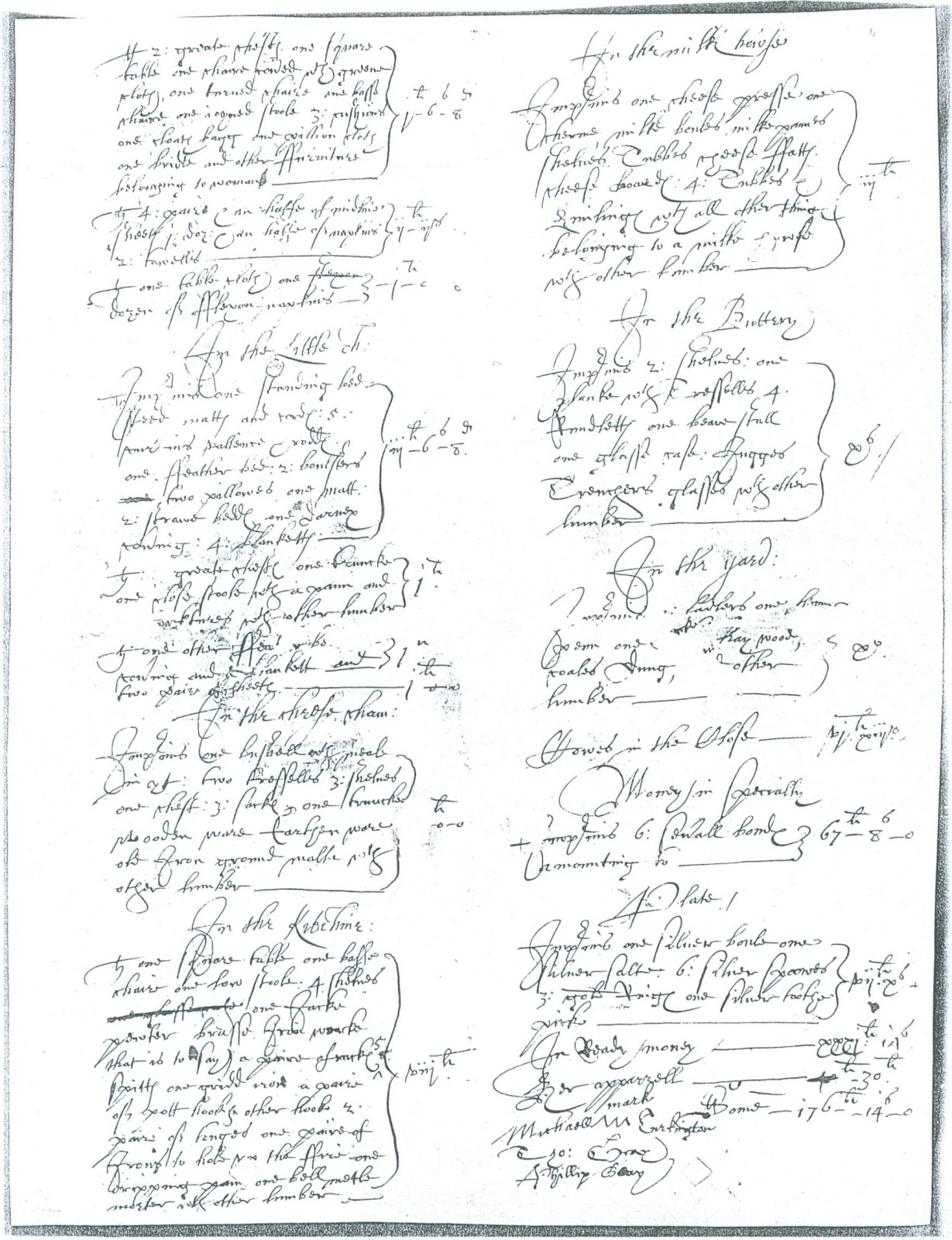
Inventory
Thomas Ginn died in 1636, his wife the next year. Thomas was 70, and his will ( National Archives) is informative. Both are buried at St Marys below with Tom's Mum. His executor (appointed by the court as next of kin - Ann was dead) was his nephew Arthur Ginn of Ely who he mentioned in his will. Unfortunately it is a probate copy, and part seems to have been incorrectly copied. Ann also left a will as mentioned above (Huntingdon Record Office). Her will dealt with her family

Thomas Ginn died in 1636, his wife the next year. Thomas was 70, and his will ( National Archives) is informative. Both are buried at St Marys below with Tom's Mum. His executor (appointed by the court as next of kin - Ann was dead) was his nephew Arthur Ginn of Ely who he mentioned in his will. Unfortunately it is a probate copy, and part seems to have been incorrectly copied. Ann also left a will as mentioned above (Huntingdon Record Office). Her will dealt with her family


