Your monument shall be my gentle verse
That eyes not yet created shall o'er read
And tongues to be, your being, shall rehearse
When all the breathers of your world are dead
You still shall live, such virtue hath my pen
Where breath most breathes - in mouths of men

William Shakespeare (1564-1616)

Sunday, 10 November 2019

Henry Ginn of "Jack Ketch's Warren" Clerkenwell died 1708

Henry Ginn here was son of Uriah in my last post.  I am sure that he would find it amusing that I say  he lived in "Jack Ketch's Warren", not least because he and his family may well have seen Jack Ketch in life (he died in 1686).  More of that later.


The Great Plague struck London in 1665, killing a fair chunk of the population.  The next year, almost like a natural event to purge the source of the disease, the Great Fire of London turned a large part of the City of London to cinders.  The timber houses had gone, the resolve was to rebuild the City in brick and stone.  In  1667 the government passed the Rebuilding Act, the aim to rebuild what had gone and the call went out for carpenters, masons, bricklayers and the like to come to London.  They were promised good wages and that the rules of the City guilds creating a "closed shop" would be removed.

Henry Ginn was a bricklayer.  He lived in Cheshunt (where I was born and my ancestors lived as Henry's contemporaries) which is close to London, to which workers commute today, and to where people moved then and now.  There was work there for Henry, so to London he went.


My guess is that Henry arrived in London quite soon after the fire, probably 1667.  He settled in St James Clerkenwell,   unaffectted by the Fire.


The old church of St James is shown above.  It was demolished in 1788 and the new church is rather impressive.  Henry married Selina Woodard at St James in 1668.  It is not clear who Selina was, she had a lovely Christian name.

Unfortunately where the couple settled was not so lovely.  They settled in Turnmill Street "one of the oldest streets in London" (Wikipedia).


Turnmill Street was famous, or rather infamous, for about 400 years, from Shakespeare's time (who with Ben Johnson and others mentions it - it was sometimes known as Turnbull Street) to the late 1800s.  A maze of alleys and courts adjoined the street and it was a den of poverty, the most serious vice , crime and disease.  Prostitutes, Pimps, thugs,  burglars, rapists and pickpockets rubbed shoulders with slum dwellers who lived in the most appalling conditions.  There was no clean water, no sanitation, each family was confined to a room and the alleys and courts running off it were so congested and narrow that occupants of houses facing each other could shake hands out of their upstairs windows !

Jack (John) Ketch was the Public Executioner for King Charles the Second, notorious for botching his job.  He died in 1686 and his name became synonymous  with the Public Hangman.  Turnmill Street and its alleys were so rife with crime it had the nickname "Jack Ketch's Warren".  Why Henry settled here I have no idea - maybe he liked the street life, maybe he had no choice - but it was no place to bring up a family.


Henry and Selina had children over some fourteen years, but we only have five names.  It seems likely there were more, but the burials largely match the baptisms and there is some suggestion in social studies of the period that birth control was practised in basic forms where living conditions were inadequate for a large family. "Selina Ginn wife of Henry of Bull Alley, Turnmill Street Bricklayer"  died in 1683.  Within  some years Henry got together with a lady called Lucy, likely a widow, and had the only known surviving son, Thomas.

                        Turnmill Street as depicted in Ogilby's Map of London of 1676


Henry Ginn of Turnmill Street apprenticed out his son Thomas (then 14)  in September 1707 which was a last flourish as Henry died in 1708 - he had done well to survive so long - he was 70.  Lucy Ginn "widow" died in 1710.

Henry and Selina (1) and Lucy (2) had the following children

Mary - born 1673, she married James Garlington of Clerkenwell in 1700, he was born in 1675 and had previously married a Phyllis Coote who died without issue.  James and Mary had a fair sized family over some 24 years, including a Phyllis named after his first wife (!) but how many survived is unclear . A James Garlington of Turnbull Street (ie Turnmill St) in Clerkenwell  is mentioned in the "Liverymen  of London 1733" (compiled in 1977) as a Freeman of the Company of Turners. The name was unique so it is obviously him.  James died in 1734 aged 63.  Mary's fate is unclear

Richard - no baptism surviving but a likely son - Richard was a family name.  If he does belong then he likely became a Freeman because Richard Ginn "bachelor of the Green" (Clerkenwell Green) below was expressed to be buried at St James "in the church" in early 1692/3.  He may have left enough money for that or perhaps being his father's only son at the time his father did..  Clerkenwell Green


 was known to be full of artisans and some of the "better sort" at the time.  In John Styrpe's Survey of London (1720) he reports a slab in the church floor marked "Richard Gynn 1692". In our calendar it would have been 1693. It is conjecture as I say, but he may be Henry's who I know I have badly underestimated.

Selina, Robert and Ann all died in infancy

Elizabeth - "spinster" died in 1707 in her 20s

Thomas -  was born in 1693. Just before Christmas in 2020 it was discovered that in September 1707, Thomas Ginn son of Henry, Bricklayer of Clerkenwell was apprenticed  to a John Davill, a joiner also of Clerkenwell.  Davill was about 12 years older than Tom and was the son of a ragman - ie a purveyor of old clothes and rags in Clerkenwell which sounds about right for this area.. 

                                      Joiner's tools of the period


 Tom was working  not far from home, though was orphaned at 17. Tom Ginn  married an Ann in about 1715, I cannot find a marriage entry and in 1720 Thomas Ginn became a Freeman of London, being entered in to the Joiners Livery Company.


He started a business on his own account, ie became a master craftsman, as he started taking apprentices (young Billy Acton - also a Londoner - in 1722) His claim to fame (for which he would be justly proud) is an entry in the British and Irish Furniture Makers Database online.  

Tom and Ann also lived in Turnmill Street, likely in the house of his father- I suspect he had carried it over. 

Hogarth's London of the 1730s - he lived in Clerkenwell

Thomas Ginn became ill and died in hospital (likely St Barts, maybe Guys) in 1732 aged 39 and was buried at St James.  Ann never remarried and died in 1760 with a quoted age of 67.  My theory is she brought up her surviving son Henry - see below - who supported her.  

Thomas and Ann had Lucy (after Mum) in 1716 (died infancy) Uriah 1717 (after grandpa - also died infancy) Elizabeth (died 1721) and  Henry Thomas 1728.   It is on  Henry Thomas that rests the hope that the Ginn line from Richard Ginn of Stocking Pelham (see post of  9th August 2012 re Ginn Band of Brothers)) survived.  A Henry Ginn married a Rebecca Wiffin at Bethnal Green in 1753.  It may well be this man


Uriah Ginn of Cheshunt died 1681

Uriah Ginn, son of Henry Ginn of Cheshunt in my post of  9th August 2012 , was a Husbandman, ie he had a house, a little land and his rights on the common.  With a life of hard work he could subsist and not starve, but it would be hard.


My family originate in Cheshunt and I was born and resided there for fifty years, so Uriah and I have walked the same paths many times. Indeed, my father attended Robert Dewhurst School 250 years after Uriah Ginn jnr did (see below).

Uriah was born in 1606, one year after Guy Fawkes met his fate.  He was born in Cheshunt proper, but Cheshunt church (St Marys) was then and is still a long way from the centre of Cheshunt, which was a large village at the time strung out over quite a large area, perhaps three miles across, encompassing Hammond Street and Cheshunt Common at one end, the High Street and Turners Hill in the middle and Waltham Cross on the far south side, towards London.  If you lived in the centre it was a long walk to Cheshunt church, and you could just as easily walk to Waltham Abbey which was across the border in Essex, across the River Lee.

It seems that Uriah initially settled towards Waltham Cross, because in 1635, aged 29, he married Mary Shepperton at Waltham Abbey (a lovely church) and had all of his children baptised there.


At some point though, certainly by 1650, he had moved to Turners Hill in Cheshunt which is close to the High Street and a stone's throw from the alms houses where his mother died.  In fact her being there may of course have motivated the move or it could be that he took over his father's cottage, Henry having died in 1647.  He was certainly back in Cheshunt "proper" because Mary died in 1653 and is buried at Cheshunt.

Uriah remarried at Cheshunt (where my parents married three centuries later) in 1654, his new bride was Elizabeth Cock "widow".  Elizabeth was born Elizabeth Askew at Cheshunt in 1615 and had married a John Cock there in 1637 and had had several children by him.  Although only 39 when she married Uriah, there was no evidence that they had had children until a document was discovered in late 2021.  This was because the children were born during the Commonwealth (ie when Cromwell ruled in the 1650s) when parish duties were often neglected and baptisms went unrecorded.


                                    St Marys  Cheshunt

From the 1650s the Vicar of Cheshunt was one Stephen Tothill, who with a view to collecting tithes did a tour of Cheshunt in 1669 listing who owned what (Theobalds Park and Cheshunt Park excluded) and published his findings as the "Perambulation of Cheshunt (HRO) in which we find (Uriah was 63) -

Uriah Ginn holdeth by free deed as garden to Cock his son in law (stepson) a cottage a garden plot taken hereto forth from the lands of Elisha Garrett and a garden plot oute of the Lord's waste and lying on the north side of forsed lane

Uriah lived on the west side of Turner's Hill and south of Pentbrook Street, so he lived not far from the "Old Pond" as it is known, ie central Cheshunt.  His son Henry having gone to London by 1669, he and his wife clearly lived with one of Elizabeth's sons, likely Leonard Cock.  Owning his property freehold probably gave Uriah the vote, relatively few men passed that property qualification.  It seems very likely he was his father's heir, Richard his elder brother having died in 1640.

Uriah Ginn died in 1681 and is buried at Cheshunt - he was 74.  It is unclear what happened to Elizabeth.

Their children

Uriah and Mary had three children:

Henry - see next post

Mary - died in infancy

Christopher - a mystery.  He was born in 1643 and is untraced.  He may well have died young in the 1650s when the Cheshunt registers were poorly kept, but his brothers survived - so he may have done too.  The name is somewhat unique this early on

Some American researchers online quote a reference for a Christopher Ginn in Virginia in the American colonies in the 1690s.  I checked this out and the reference is spurious.  The Virginia State Library told me that have no record of it and told me that they have no Christopher Ginn or similar in the indexes to early documents

Uriah and Elizabeth likely had at least two children but the only one known is

Uriah - he must have been born in 1659 or so, and he went to school.  See post of 19th January 2022


Thursday, 10 October 2019

Billett King Genn of Cambridge and Wandsworth died 1886

King Genn as he was magnificently known throughout his long life, was born to Charles Genn and Susanna in my last post in 1805, the year of the Battle of Trafalgar.  He was orphaned at the age of 6.

I do not think there is any doubt but that King was brought up by his Uncle Robert at the Lamb Hotel in Ely.  My main reason for saying that was that he was brought up as "King" not Billett, Robert having a son called Billett and the one was not to be confused with the other.

King Genn married Mary Wilson Talbot (a Cambridge girl  - dtr of William and Ann) at St Giles London in 1835, Mary was 20.  They settled in Cambridge.

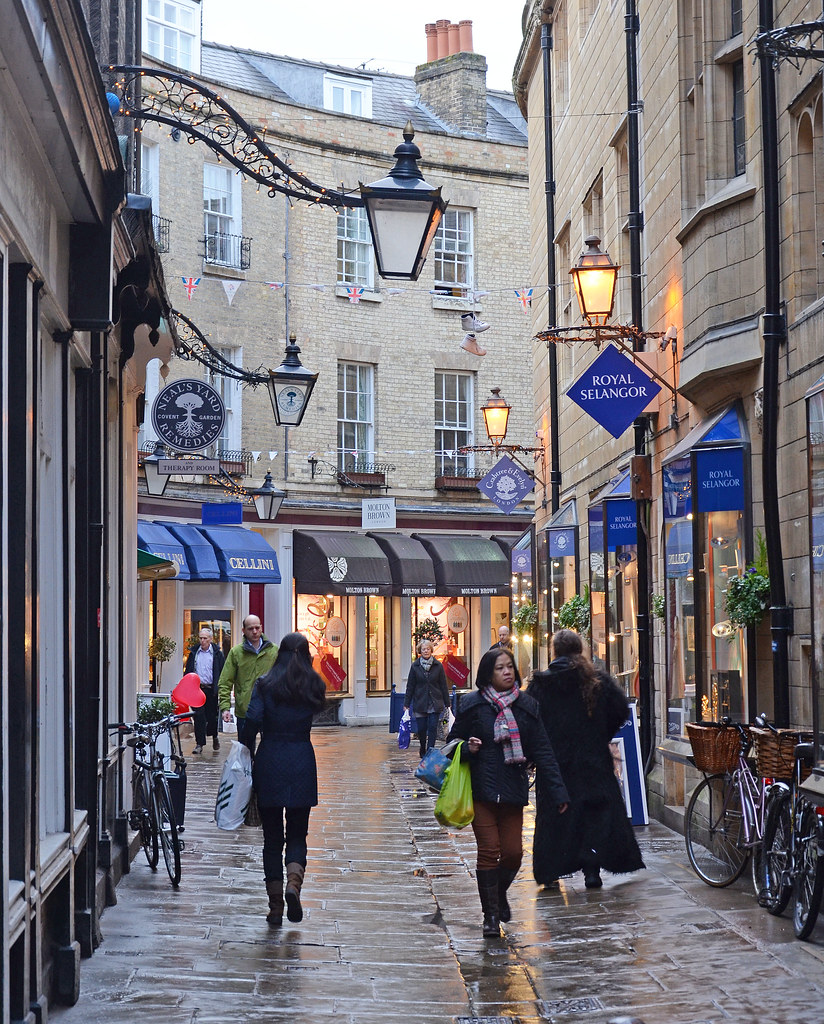
King was (somewhat amazingly given his ancestry in the 17th century)  first a tailor, robemaker and hatter and had a shop in Rose Crescent, still a popular shopping street in Cambridge.   My guess from his being a robemaker was that he catered for the university set.  I know that he put himself about in the 1830s, and was a member of the Cambridge Garrick Club, the cousin of the London theatrical club of that name.


                                            Rose Crescent


 In 1844 however, tragedy struck, as King was clearly in serious debt, entered into a deal with is creditors and the local newspapers reported that his goods were sold at auction, including household stuff such as four poster beds, Pembroke tables and linen, together with stock in trade such as beaver hats, caps, silk, drill and lengths of twill together with a life assurance policy for £500.  So King lost his shop.

The family briefly went to Willow Walk but by 1851 were in Brunswick Place, King having pulled things together and established himself as an accountant.

By 1861 the family were in Nelson Place, and things took a turn for the worse again in 1863, the Cambridge Independent Press reporting a court case (also reported in the Cambridgeshire Archives) where it seems King was behind on the rent and the family were evicted from their house in Nelson Place.  He was in a bit of a state at this time and I know was a Sexton at St Edwards Church and was dismissed from his post in 1866 because he was not carrying out his duties satisfactorily (Cambs Archives)

.
St Edward

King stayed as an accountant the rest of his life. They continued to move around, likely renting, being at 29 Bullen Place in 1871 and 16 Union Road Cambridge in 1879 where Mary sadly died aged 63.

While still at Union Road in 1881, King shortly afterwards moved to Wandsworth in London, perhaps to be nearer to one of the children.  He died there in 1886 aged 81.  He and Mary are both buried with  a gravestone in Mill Road Cemetery Cambridge.

King and Mary had nine children:

Mary Ann - died unmarried in 1879

Annette Talbot - married Jesse Ross in 1862 - they went to London
and there are descendants

William Henry - he married Emily Sarah Styles (a Cambridge girl) in Richmond in Surrey in 1876.  They had only the one child, Violet Birdie, who died unmarried.  Exceptionally for this study, William was a Landscape Artist - he obviously made a living at it but no works are known.


In 1863 he was a Pupil/Teacher at the Cambridge School of Art which was founded by John Ruskin in 1858 and is still going strong below


Sadly William  died prematurely on Christmas Day 1891 aged 50.  He is buried with his parents. Emily ran a lodging house thereafter, never remarried and died in 1933 buried with her husband and in laws in Mill Road Cemetery Cambridge.

Susannah King - married Stephen Adams in 1900

George Charles - married Elizabeth Smith Ablett in Chelsea in 1874.  He was a clerk and they lived in Surrey.  It is unclear whether there were issue.  George died prematurely in 1887 aged 42.  Elizabeth remarried David Gill in Chelsea in 1892.

Emily - she lived in Surrey with her sister Susannah for a time, was  later a Cook and never married, working at one point for a well known golf club.  She died in 1918 aged 71

Martha Charlotte - died unmarried with her Dad in Wandsworth in 1882 aged 32.

Florence Kate - married Stephen Nicklen in Wandsworth in 1880

John James - died in infancy


Acknowledgement - I am indebted to the Friends of Mill Road Cemetery, Cambridge, for some of the information that appears here


Charles Genn of Ely died 1811

Charles Genn here was the youngest son (b.1776) of Richard Genn of Ely (see post of  9th March 2013 ) and brother of Robert and Denton.  He was ignored by all prior researchers of the Genn  family.

In 1802 (baptised1803) a Henry Fleet was born to an Ann Fleet of Ely (born 1782) who died in childbirth.  The midwife said that before death Ann gave Charles as the father.  There is a record at the Cambridgeshire Archives that Chas. was ordered to pay maintenance.  Henry was likely taken in by the parish, and he sadly died in 1815 aged 12.

Charles Genn was a baker.  He owned his premises which were in Ely, St Mary parish and  he was in business by at least 1802 as he was fined in the Petty Sessions at the Magistrates Court for serving up lightwight loaves.  He therefore had his shop on the west side of Ely, near St Mary's, but I do not know where.

                                     St Mary Ely, with the parsonage (one time house
                                             of Oliver Cromwell) in the foreground

In 1804, Charles Genn married Susannah King by Licence at Bottisham, her origins are not entirely clear. They only had one child, born in 1805.

During the Napoleonic Wars, the country was on high alert against invasion, men not only joining the Army (there was no conscription) and the official full time County Militia regiments (for Home Defence) but also local worthies raised units of part time civilian volunteers, largely tradesmen, kitted out in ad hoc uniforms reflecting the true military and the men enjoying "playing at soldiers"

Sgt Major


I know that Charles was the Sergeant Major of the Ely Regiment of Volunteers, in 1807 he was enjoying  himself so much in the role that he complained to the magistrates in Petty Sessions that a local millwright, Robert Wilkinson, had obstructed Charles "in carrying out his military duties" !

Susanna Genn died in 1810, it is unclear why - she was given as 32.  Charles was friendly with a lady called Margaret Varnum, who I know had worked for his brother Robert at the Lamb Hotel since at least 1802 (Petty Sessions records again) and in early 1811 Charles married her by Licence at Bury St Edmunds in Suffolk (St James) from whence she came.

The Lamb today is scarcely changed

But sadly they were not together long, for in October 1811 Charles himself died - he was 35.  His only child, aged 6, was now an orphan.  

Charles left a will (CRO), the original of which survives, his signature from that is below


Margaret remarried  William Cooper at Ely in 1815.

The only child

Billett King Genn - see next post


Sunday, 10 March 2019

William Genn the younger of St Stephen,Coleman London died 1830

I am confident that William here was son of the William in the last post, though I freely admit that I rely purely on circumstantial proof.

William here was born in Ely Trinity (ie near the Cathedral) in 1766.  Whilst a babe in arms he was transported to Hoddesdon in Hertfordshire where he stayed until 1774, perhaps 1776.  His father then clearly moved to London where he appears in 1777.


St Stephen Coleman

William here then seems to have spent some years in Islington, at least until 1788 it seems.

Lydia Philpott was born in St George's in the East (East End of London) in 1773 to John and Sarah, John was a Bricklayer.  They were a large family, and Lydia was obviously close to her brother Richard.

Lydia married William Genn at Bermondsey of all places in 1793, she was barely 20 and he 27.  The marriage is incorrectly indexed on Ancestry (Genn transcribed as Gown) and this caused me a problem for a while, though I knew that Lydia had been a Philpott.


The marriage

The couple lived first in St Georges, because I know that Lydia was a Mantua (Dress) maker, and she took an apprentice, a local girl called Sarah Household in 1798, and was expressed to be wife of William. The Land Tax has them there to 1808, they lived  in a tenanted house at the north end of Princes Square, so they had their own place. William and Lydia sadly never had any children.  By 1810 they were living in the Minories in the City and by 1812 they were living at 7 Great Bell Alley, St Stephen Coleman in the City , likely moving in 1810  because of Bill's new job, see below. It sadly no longer stands as it was, being demolished in the Blitz of 1940.


The United States of America have inherited from their English cousins and former founding colonists the role of  County Sheriff, which is more than 1000 years old (Shire Reeve in Anglo Saxon times) and still exists in England, though large ceremonial today.

In London there were two Sheriffs elected each year -there still are. The Sheriffs are part of the machinery of the City of London, linked to the Guilds and the Lord Mayor of London (below). Their role by 1800 was largely in the serving and enforcement of writs, some involvement at the Old Bailey (Central Criminal Court) and the sad duty of making sure that criminals sentenced to hang received their punishment.

What we know is that both William and his  Brother in Law, Richard Philpott, were  Sheriffs's Officers by 1810, in other words they were Court Officers and "Enforcers".  They lived  local to the job and in fact even lived  together at No 7 - in Great Bell Alley/


It was perhaps a natural job for William, his grandfather Richard (who he had known as a boy) had been Constable for both the City of Ely and Hoddesdon, and Bill had likely been attracted by the respect that grandfather Dick had commanded.

Great Bell Alley was like much of London of Dickens, rows of houses with families in tenements above and below but Bill seems to have all of his house - the houses were three storey and  the area lively - day and night.  Illustrations of 1818 and 1823 show the adjacent Little Bell Alley below - I particularly love the washing line.


 It was a long alley and though still there (rebuilt in the 1980s and before ) is much shorter than in William's day.


As I say, William and Lydia never had any children.  William died at Great Bell Alley in 1830 with a quoted age of 64, exactly correct (wrongly transcribed as 54 on Ancestry).  He  was buried at St Stephens. He left a will ( PCC) and left everything he owned to Lydia.

Richard Philpott continued to live with Lydia at 7  Great Bell Alley  and became the householder in the Street Directory of 1832 but by 1842 was at No 13, because Lydia remarried.

Street Directory 1842


In 1838 Lydia married a certain Joseph Voy from Gravesend in Kent, a widower and Ship's Pilot.  She spent her last days there, dying in Gravesend in 1847 aged 74.


Saturday, 9 March 2019

William Genn the elder of Ely, Hoddesdon & London died 1780s ?

William was son of Richard Genn of Ely and Hoddesdon (see post  of  3rd February 2013)  and after twenty years is still being researched.  I am the first to research him.  He was a Shoemaker/Cordwainer.  He married Hannah Eastwell at Ely in 1764 and they had one child there, William, before in October 1766 making the move to Hertfordshire with his parents.  

I have absolutely no idea why he moved so far south and why to Hoddesdon.  His Certificate of Settlement for the Poor Laws is referenced D/P24A/13/5 at the Hertfordshire Archives, shoemakers barely made a subsistence wage it seems.  I have a copy somewhere and will add it to the blog shortly.  At the time of the move his brother John appeared before the Ely Justices to swear that the signature of the Churchwardens of Trinity Ely was affixed in his presence.


Whilst in Broxboume (the parish in which Hoddesdon is situated) he and Hannah had a further three children, two of whom died in infancy.  Hannah herself died in October 1773 and William remarried (as Genn) to Jane Bain at Gt Amwell Herts in January  1774. Whist in Hoddesdon the parish clerk invariably recorded them as Ginn.


Until 2019 I was confident that Jane was the "Jane Ginn of this parish" who was buried at Broxbourne in the summer of 1776, probably in childbirth I thought.  Events in 2019 have made me wonder.


Hertfordshire is very lucky in that the 18th century Militia Lists for the county invariably survive - they record every male of a certain age and, if in Broxbourne, should have counted William until he either had three children or was 45.  William is in the Militia List at Broxboume until 1773 (stated to have three children) as a Shoemaker.   His children William, Hannah and Richard were alive at this point.


What happened to William was a mystery.  He disappeared from Hertfordshire but did not go back to Cambridgeshire.  The name is far rarer than Ginn and that is rare, but I could not find him.  His son Richard died at Hoddesdon in 1774, and Jane I thought in 1776 - so where did he go?

Now 2019 has seen me almost certainly finding his son, so he likely went to London, but where was William snr ?


There is no mention of William on Family Search, or Findmypast, or Ancestry, but look at Londonlives and I am sure he turns up in the Middlesex Sessions (Court records) for in 1777 and again in 1781 we have William Genn and his wife Jane, he a shoemaker, coming up before the Magistrates for Assault - he and Jane were a pugnacious couple it seems.  Ironically, that same year, ie 1781, he was one of the many Constables of St Lukes, so he followed his father in that. So either the first Jane did die and he swiftly found another (like he replaced Hannah) or the first Jane survived.  The most likely scenario is that the buried Jane was an unbaptised infant of the couple - the parish clerk did not distinguish children from adults.  We even have an exact address, they lived at 73 Golden Lane, which is St Lukes Islington, North London, pretty much where I would expect immigrants from Hoddesdon to turn up and where Ginns from this blog had arrived previously …. research continues......but the Land Tax shows William there until at least 1788 (when son William was 22)……..


                                     William Genn in London 1781


William and Hannah had four children and he and Jane one

William - born in Ely but  went to Hoddesdon as an infant and alive aged 7 in 1773.  See next post


Mary - died infancy


Hannah  - alive in 1773 aged 2.  Untraced


Richard - died in 1774 in infancy


--------------------------------------------------------

Jane - died infancy in 1776